

Most naughty games go too fast. You draw a card, do it, move on to the next, and the evening ends up looking like a checklist rather than a shared moment. Crescendo takes the opposite view: you choose a duration, the game composes a sequence, and every card has its own timer. Waiting is not a flaw in the game. It is the game.
What mindfulness changes about intimacy as a couple
Several approaches in sexology and couples therapy have, in recent years, looked at the benefits of mindfulness applied to intimacy: getting out of autopilot, focusing on what is actually felt rather than on a goal to reach, and giving value back to the journey rather than the destination alone. That is exactly what Crescendo puts into practice without naming it: a timer that stops you going faster than planned, and an instruction that invites you to stay present to what is happening during the minute or two each card lasts, rather than thinking about the next one. Try the Crescendo game.
Four phases, a real progression
The game is built in four movements, in a fixed order that gives the game its name. Douceur first: looks, massages, whispered words, over roughly a fifth of the chosen time. Then Tension: the caresses become more precise, clothes come off gradually, without anyone being allowed any further yet. Then comes the longest phase, where nothing is held back. And finally, the last phase always ends with the same card: permission, at last, to finish, and the timer stops. This staircase structure avoids the pitfall of games that jump from one extreme to the other without transition, and gives each stage time to settle before moving on to the next.
Why choosing your duration changes everything
Unlike a game with a fixed number of rounds, Crescendo is chosen in time: 20, 30, 45 or 60 minutes. This logic has a real practical advantage: it lets you fit the game to the time available rather than having to cut a game short. Twenty minutes suit a taster on a weeknight very well, when time is short but the wish to reconnect is there. A sixty-minute session, on the other hand, lends itself to a proper evening, with nothing else on the horizon.
A glimpse of the Douceur phase
A few examples among the sixteen cards of the first phase, to set the tone: gently massaging the shoulders and the back of the neck for two minutes, kissing tenderly without tongue for one minute, stroking the other’s face with your fingertips while they keep their eyes closed, or slow dancing without music, just humming. The Tension, Chaleur and Extase phases, on the other hand, only reveal themselves in the game.
How to play it well
The most important starting point is to choose a moment when nothing is waiting afterwards: twenty minutes are enough, but they must be genuinely free, with no message to answer and no oven timer in the background. The game also asks how many pieces of clothing each of you is wearing at the start, information it then uses to get them off gradually during the Tension phase, at the right pace. Each timer starts when you are ready, never before, and chimes softly at the end. And if a card lands badly, it simply gets skipped: another from the same phase takes its place, without breaking the rhythm of the sequence.
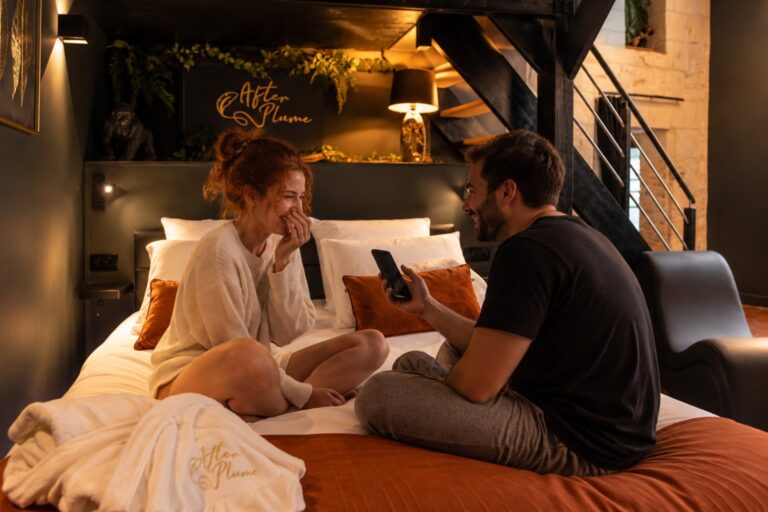
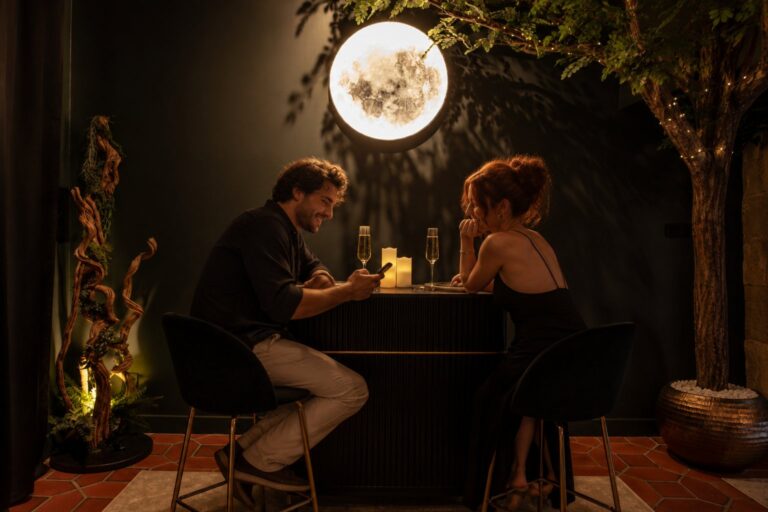
Fancy playing somewhere other than your living room? Our love room in Tours, with a jacuzzi, sauna and a hanging net facing the screen, was designed for exactly this kind of evening.
 Recommended reading4 free couple games to try during your next evening for twoTo laugh, to talk, to slow down or to dare: our four couple games don't serve the same purpose. This article helps you pick the right one for tonight.Read the article →
FAQ
Frequently Asked Questions
How is Crescendo different from a classic naughty game?
Most games deal one card after another with no pacing. Crescendo puts a timer on every card and builds a progression in four phases, so that waiting becomes part of the experience rather than something to avoid.
How long does a game last?
You choose the duration at the start, between 20 and 60 minutes, and the game composes its sequence of cards to fit that time.
What happens in each phase?
Douceur focuses on tender gestures, Tension gradually gets the clothes off, the next phase holds nothing back, and the last one always ends with the same card that grants permission to finish.
Why does the game ask how many pieces of clothing we wear?
To synchronise their gradual disappearance during the Tension phase, so that both players are naked at the same moment when the next phase begins.
Can we skip a card that doesn’t suit us?
Yes, at any time and without explanation: another card from the same phase replaces it immediately.
Fancy trying it tonight?